
Research and publications
In brief
- Associate Professor, University of Sydney
- PhD in retinal vein occlusion, Save Sight Institute, completed 2025
- Investigator, RVO module, Fight Retinal Blindness! registry
- Co-author of more than twenty peer-reviewed papers
- Member, TGA Advisory Committee on Medicines
Research and academic roles
A/Prof Hunt's research is built around a practical question: how do treatments for retinal disease actually perform in everyday practice — not just in clinical trials, but in real patients, over real time?
He has been the investigator on multiple analyses of retinal vein occlusion outcomes using data from the Fight Retinal Blindness! (FRB!) registry at the Save Sight Institute, University of Sydney — a clinical database that collects treatment outcomes from ophthalmologists across Australia and internationally. Clinical trials tell us how treatments perform under ideal conditions; registry data tells us what actually happens in routine care, over years. That distinction matters, because retinal conditions are typically lifelong.
He is an active co-author on more than twenty peer-reviewed papers covering intravitreal therapy in macular degeneration, retinal vein occlusion, and diabetic eye disease — frequently performing the data analysis and drafting the manuscript. He regularly presents findings at national and international conferences, including RANZCO, EURETINA, ARVO, and ASRS.
He is an Associate Professor at the University of Sydney and teaches ophthalmology registrars at Westmead Hospital, where he has been a Staff Specialist since 2007. He also serves on the Therapeutic Goods Administration (TGA) Advisory Committee on Medicines, contributing to the national evaluation of new therapies before they become available to Australian patients.








What the research has found
Retinal Vein Occlusion
One of the most common questions patients ask is: how long will I need injections, and how often? A/Prof Hunt's PhD research used data from thousands of real patients to understand why treatment needs vary so widely.
- Long-term outcomes are encouraging. Three-year data showed that patients who start treatment promptly and maintain it consistently achieve meaningful, sustained improvements in vision. Published in Ophthalmology Retina (2023).
- Some eyes can eventually pause treatment and stay stable. Among eyes that responded well to injections, around half were able to stop and remain stable for at least two years — and a strong early response that continues to improve helps identify who is likely to manage without ongoing injections. Published in the British Journal of Ophthalmology (2026).
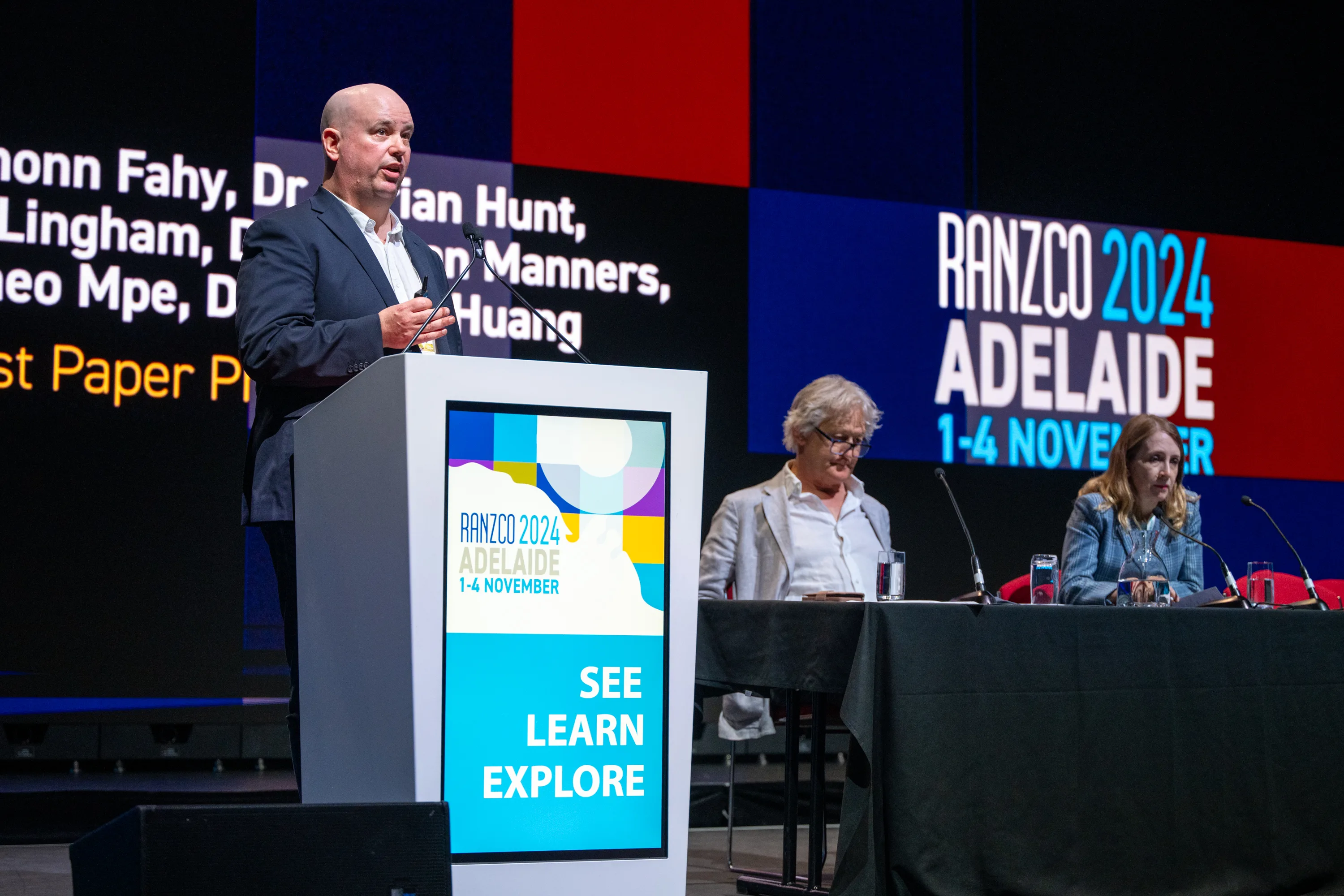
- Treatment intensity varies between practitioners — and it matters. Ophthalmologists differ substantially in how frequently they treat RVO, and the outcomes reflect that variation. Published in Clinical & Experimental Ophthalmology (2025), presented at the RANZCO 2024 Best Paper Session.
- Hemiretinal vein occlusion is a unique entity that responds particularly well. HRVO has historically been lumped in with branch or central RVO in trials, potentially skewing the results of both. Published in the British Journal of Ophthalmology (2022).
- Steroid implants are a valid alternative to anti-VEGF injections. Published in Scientific Reports (2024).
- Both main anti-VEGF medications work well. Published in the British Journal of Ophthalmology (2021) and Acta Ophthalmologica (2022).
What this means for patients: If you have retinal vein occlusion, the benchmarks for how your vision is likely to respond, how long treatment typically continues, and when adjustments are appropriate come directly from this work.
Macular Degeneration
- Switching to faricimab maintains good outcomes. Published in Clinical & Experimental Ophthalmology (2025) and selected as Editor's Choice by the American Academy of Ophthalmology.
- Initial treatment response predicts long-term vision. Published in Ophthalmology (2019).
- Some eyes respond poorly despite treatment. Published in Ophthalmology Retina (2024).
What this means for patients: The decisions about which medication to use, whether to switch agents, and what to expect over the coming years are informed by this research.
Diabetic Eye Disease
- Treatment gaps matter. Published in the British Journal of Ophthalmology (2025).
- Poor outcomes are not always explained by undertreatment. Published in Ophthalmology Retina (2022).
What this means for patients: This research reinforces the importance of consistent follow-up and helps identify when a different treatment approach may be needed.
Cataract Surgery
Cataract surgery can be performed safely in eyes receiving ongoing intravitreal injections for retinal vein occlusion, with meaningful gains in vision — although patients may require a slight increase in injection frequency in the twelve months following surgery. Published in Clinical & Experimental Ophthalmology (2025).
Selected publications
The full record is on Google Scholar and ORCID.
Retinal Vein Occlusion
- Hunt AR, Hashimoto Y, O’Toole L, et al. Suspending vascular endothelial growth factor inhibitors in eyes with retinal vein occlusion. British Journal of Ophthalmology. 2026. — DOI
- Ponsioen T, Hashimoto Y, Invernizzi A, et al. Outliers of Treatment Frequency in Retinal Vein Occlusion. Clinical & Experimental Ophthalmology. 2025;53(4):409-420. — Full text (open access)
- Invernizzi A, Airaldi M, Cozzi M, et al. Impact of cataract surgery on patients receiving intravitreal therapy for retinal vein occlusion. Clinical & Experimental Ophthalmology. 2025;53(4):374-383. — Full text (open access)
- Garay-Aramburu G, Hunt A, Arruabarrena C, et al. Initial response and 12-month outcomes after commencing dexamethasone or VEGF inhibitors for retinal vein occlusion. Scientific Reports. 2024;14:6122. — Full text (open access)
- Alforja S, Hunt A, Nguyen V, et al. Three-Year Outcomes of VEGF Inhibitors in Naive Branch Retinal Vein Occlusion. Ophthalmology Retina. 2024. — DOI
- Hunt A, Nguyen V, Bhandari S, et al. Central Retinal Vein Occlusion 36-Month Outcomes with Anti-VEGF. Ophthalmology Retina. 2023;7(4):338-345. — DOI
- Hunt AR, Nguyen V, Arnold JJ, et al. Hemiretinal vein occlusion 12-month outcomes are unique with vascular endothelial growth factor inhibitors. British Journal of Ophthalmology. 2022. — Full text (open access)
- Wang N, Hunt A, Nguyen V, et al. One-year real-world outcomes of bevacizumab for macular oedema secondary to retinal vein occlusion. Clinical & Experimental Ophthalmology. 2022;50(9):1038-1046. — DOI
- Niedzwiecki M, Hunt A, Nguyen V, et al. 12-month outcomes of ranibizumab versus aflibercept for macular oedema in central retinal vein occlusion. Acta Ophthalmologica. 2022;100(4):e920-e927. — Full text (open access)
- Hunt AR, Nguyen V, Creuzot-Garcher CP, et al. Twelve-month outcomes of ranibizumab versus aflibercept for macular oedema in branch retinal vein occlusion. British Journal of Ophthalmology. 2022;106(8):1178-1184. — DOI
Macular Degeneration
- Hunt A, Hashimoto Y, Young S, et al. Outcomes After Switching to Faricimab in Neovascular Age-Related Macular Degeneration. Clinical & Experimental Ophthalmology. 2025. — Full text (open access)
- Hashimoto Y, Hunt AR, Wells JM, et al. Outlier ophthalmologists in the treatment of neovascular age-related macular degeneration. British Journal of Ophthalmology. 2025;109(5):606-613. — Full text (open access)
- Boudousq C, Nguyen V, Hunt A, et al. Real-world unmet needs in poorly responsive neovascular age-related macular degeneration in Europe. Ophthalmology Retina. 2024. — DOI
- Nguyen V, Daien V, Guymer R, et al. Projection of Long-Term Visual Acuity Outcomes Based on Initial Treatment Response in Neovascular Age-Related Macular Degeneration. Ophthalmology. 2019;126(1):64-74. — DOI
Diabetic Macular Oedema
- Hashimoto Y, Hunt AR, Silva R, et al. Differentiating treatment episodes from gaps in eyes with diabetic macular oedema. British Journal of Ophthalmology. 2025;109(11):1279-1282. — Full text (open access)
- Shah J, Nguyen V, Hunt A, et al. Characterization of Poor Visual Outcomes of Diabetic Macular Edema. Ophthalmology Retina. 2022;6(7):540-547. — DOI
- Bhandari S, Nguyen V, Hunt A, et al. Changes in 12-month outcomes over time for age-related macular degeneration, diabetic macular oedema and retinal vein occlusion. Eye. 2022. — Full text (open access)
Cataract Surgery
- He G, Nguyen T, Hunt A. Comment on: Focus on reuse — reducing waste associated with topical preoperative antiseptics. Journal of Cataract & Refractive Surgery. 2024;50(5):546-547. — DOI
Presentations, articles and research news
- May 2026 Insights and Highlights from the FRB! Retinal Vein Occlusion Module — ANZSRS 2026
- April 2026 Retinal Vein Occlusion: What a Decade of Real-World Data Tells Us
- March 2026 Can Injections for Retinal Vein Occlusion Ever Be Stopped?
- December 2025 PhD Conferral — University of Sydney
- May 2025 miVision — Retinal Vein Occlusion: Current and Future Management
- November 2024 How Treatment Intensity Varies in Retinal Vein Occlusion — and Why It Matters
- August 2024 Switching to Faricimab for Wet Macular Degeneration — What the Evidence Shows
- May 2024 miVision — FRB! Research: So Much More Than Number Crunching
- October 2023 EURETINA 2023 — Presentation at Euretina in Amsterdam
- June 2023 HealthED Clinical Takeaway Podcast — Macular Degeneration Prevention
- March 2023 Three-Year Injection Outcomes for Central Retinal Vein Occlusion
- June 2022 Hemiretinal Vein Occlusion — A Unique Entity That Responds Well to Treatment
- September 2021 Comparing Injection Treatments for Retinal Vein Occlusion — Ranibizumab vs Aflibercept