
Vision Standards for Driving in NSW
"Am I still allowed to drive?" is one of the questions patients ask most often once they have an eye condition, and it is an important one, because for many people a licence is independence. The good news is that the standard is clear. Glasses may or may not be required to reach it.
The rules are national. They are set out in the Austroads publication Assessing Fitness to Drive, and Transport for NSW applies that standard here. Two things are measured: how clearly you see (visual acuity) and how wide you see (visual field). Both matter, and the standard is higher for commercial drivers than for a private licence.
Acuity is the part people think about, and it does matter. The visual field is the one that gets underestimated. Driving is not really a test of how well you read a number plate. It is whether you see the car beside you when you change lanes.
How Clearly You Need to See — Visual Acuity
Acuity is the sharpness of your central vision, measured on a letter chart. You are allowed to wear your glasses or contact lenses for the test — if you meet the standard with them on, you simply drive with them on.
- Private licence (car, motorcycle): at least 6/12 with both eyes together. If you fall below 6/12, a conditional licence may still be possible down to 6/24 with additional assessment; below 6/24 a private licence is not issued.
- Commercial licence (trucks, buses, taxis, rideshare): a higher standard — at least 6/9 in the better eye and no worse than 6/18 in the other eye.
This is one reason an up-to-date glasses prescription matters, and why a cataract that has blurred vision below the standard usually needs attention — vision is generally restored well above the threshold once the cataract is removed.
How Wide You Need to See — Visual Field
Your visual field is the whole area you can take in while looking straight ahead — including everything to the sides. It is what lets you notice a car or a pedestrian approaching from the edge of vision, so it matters for driving just as much as sharpness does.
- Private licence: a horizontal field of at least 110 degrees, with no significant gap within the central part of vision. If that is not met, a conditional licence may still be considered down to a 90-degree field, taking additional testing into account.
- Commercial licence: stricter again — a significant field defect of any kind means the standard for an unconditional commercial licence is not met.
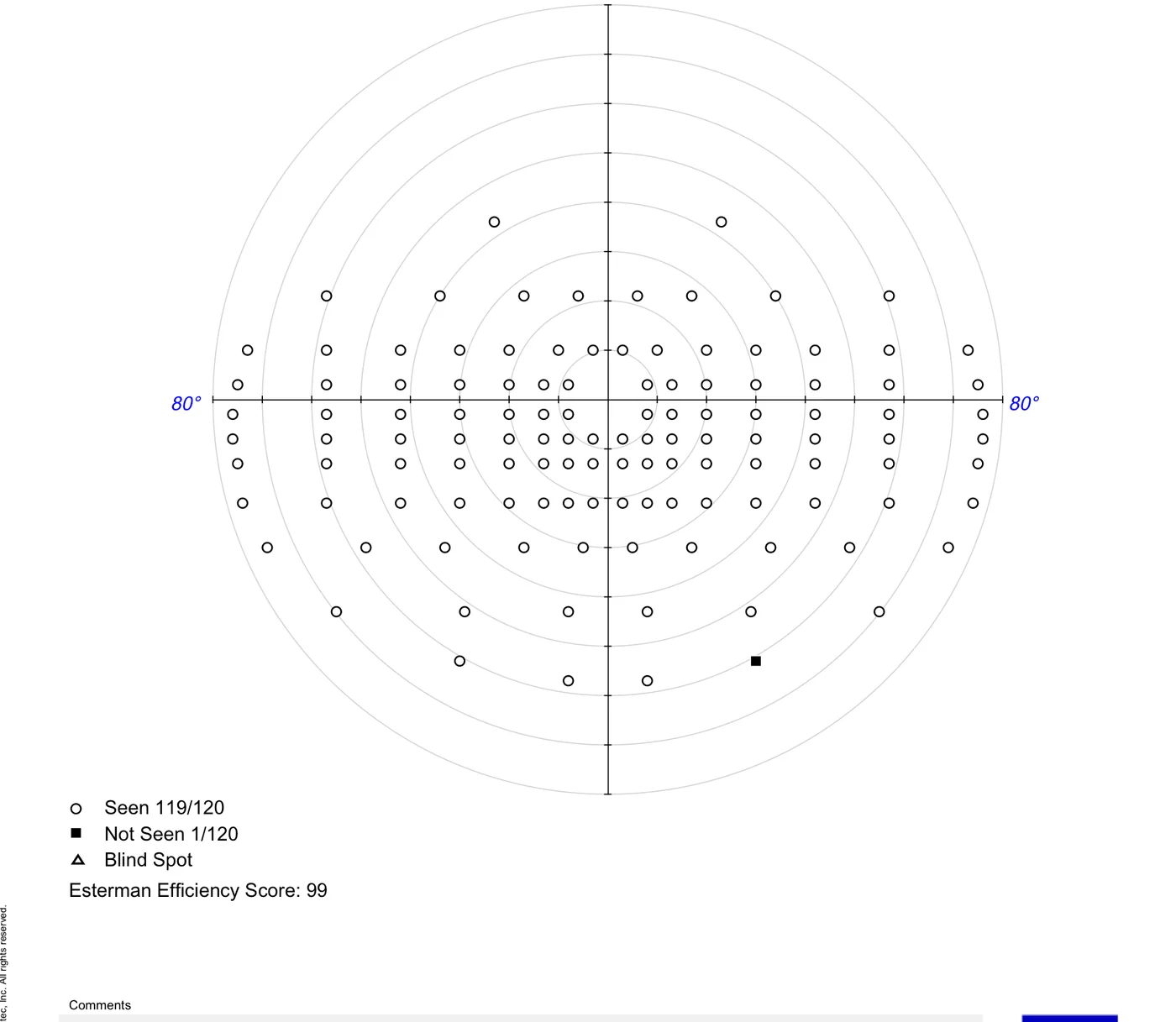
When there is any concern about the field — or a condition that can affect it — the field is measured formally rather than by rough confrontation. The definitive test for driving is done with both eyes open together (an Esterman binocular field test), because that reflects how you actually see the road.
Driving With an Eye Condition
Most eye conditions affect licensing through one of the two measures above rather than through any special rule:
- Glaucoma and other conditions that damage the field are the ones to watch, because side vision can be lost gradually and silently. This is where formal field testing matters most.
- Macular degeneration and diabetic retinopathy tend to affect central acuity, and sometimes the field. Regular review keeps track of where you stand against the standard.
- Cataract reduces acuity and adds glare; both usually recover after surgery.
- Sight in one eye only: for a private licence this is generally workable if the seeing eye meets the acuity standard and the combined field is at least 110 degrees, with a yearly check of that eye. Commercial driving with one eye is generally not permitted.
- Double vision has its own rules; if it is managed with a patch over one eye, a short non-driving period applies while depth perception re-establishes.
Conditions that can progress — glaucoma, cataract and others — are monitored over time, so that any change affecting driving is picked up early and discussed before it becomes a problem.
Vision Is More Than the Eyes
Sight does not end at the eye. The signal leaves the retina along the optic nerves, passes through the optic chiasm into the optic tracts and the visual radiations, and travels back to the occipital cortex at the rear of the brain. All of that pathway has to be intact for the visual field to be complete.
It is why a number of neurological conditions, stroke among them, can remove half the visual field in both eyes while the eyes themselves examine as entirely normal. A loss of that kind matters a great deal for driving, and it is not always obvious to the person who has it.
It is also part of why the driving field test is done with both eyes open. A problem sitting behind the chiasm takes the same side of the field from each eye, and only a binocular test shows what that actually leaves you with on the road.
Driving Is More Than Just Vision
Vision is one part of fitness to drive, and it is the part assessed here. It is not the whole of it.
Capacity to drive also depends on cognitive function, physical strength and mobility, medication, and other medical conditions. Your general practitioner knows your overall health and is the person best placed to weigh those together.
In practice the medical assessment form is shared between us. We complete the section covering your vision, and your general practitioner completes the rest.
Do You Have to Tell Anyone?
Yes. If you have a permanent or long-term condition that could affect your driving, you have an obligation to notify Transport for NSW — usually when you renew your licence, or when the condition is diagnosed.
Your eye specialist and GP are there to advise you, and to provide the vision reports that Transport for NSW may ask for. In NSW a treating doctor may also notify Transport for NSW directly if they are genuinely concerned about safety, and are protected in doing so — but the aim is always to work through it with you first.
It is worth being clear on one point: the final decision about your licence, and any conditions placed on it, rests with Transport for NSW, not with the doctor. The clinician's role is to measure your vision accurately and advise.
How We Can Help
At Eye Surgeons Miranda, A/Prof Hunt can assess both parts of the standard — acuity and visual field — and carry out formal binocular field testing in the rooms when it is needed. If you are worried about whether you still meet the standard, an assessment gives you a clear, honest answer and, where a licence is at stake, the reports Transport for NSW requires.
Glaucoma and visual field loss →This page is general information. The standards are set by Austroads (Assessing Fitness to Drive) and applied by Transport for NSW, and can change over time. Your own situation should be assessed individually, and licensing decisions are made by Transport for NSW.