
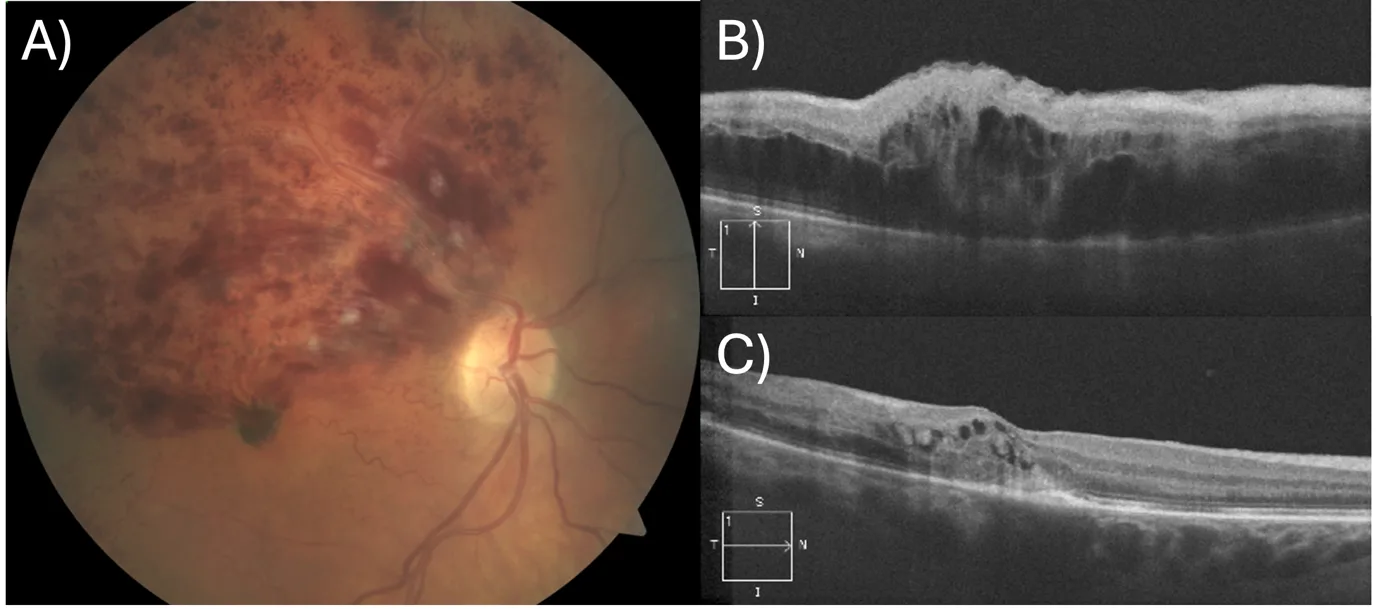
The Save Sight Institute’s patient newsletter, MacularNEWS, has devoted its Autumn 2026 edition to retinal vein occlusion — the condition behind a large share of the injection treatment carried out in retinal clinics. The edition also profiles A/Prof Adrian Hunt’s work as an investigator in the retinal vein occlusion module of the Fight Retinal Blindness! (FRB!) registry.
Retinal vein occlusion happens when one of the veins draining blood away from the retina becomes blocked. The result is bleeding and swelling, and vision is affected when that swelling reaches the macula — the central part of the retina responsible for detailed sight. Anti-VEGF injections, which reduce the swelling, are the first-line treatment.
Real-world evidence, not just trial conditions. Most of what is known about these treatments comes from clinical trials run under tightly controlled conditions. The FRB! registry takes a different approach — it tracks outcomes from thousands of patients treated in everyday practice across Australia and internationally, and has been doing so for more than ten years. That makes it one of the clearest available pictures of how treatment works once it leaves the trial setting and meets the realities of ordinary life.
What patients can expect. A consistent message from the registry is that retinal vein occlusion is usually a long-term condition. The data suggest patients receive around eight injections in the first year, fewer in the years that follow, and that roughly half still need ongoing treatment after three years. Reassuringly, the condition affects one eye only in most people. Outcomes vary — branch occlusions generally do well — and how consistently treatment is given makes a genuine difference, particularly for central retinal vein occlusion, where sustained treatment matters most.
The registry has also compared the medications that have been available up until now, and will be in a position to study newer agents as they become used in real-world practice — hopefully allowing longer intervals between injections while maintaining similar outcomes. And in a finding that reassures many patients, the data show that cataract surgery can be carried out safely in people who are having injections for retinal vein occlusion.
What this means for patients: The clearest lesson from a decade of registry data is that the single most important factor patients can influence is sustained engagement with treatment — keeping to appointments and staying in regular contact with the treating doctor. A/Prof Hunt manages retinal vein occlusion from diagnosis through long-term monitoring at Eye Surgeons Miranda, and the same registry research he contributes to informs how each patient’s treatment is planned.
MacularNEWS is published by the Save Sight Institute at the University of Sydney. You can read past editions and subscribe.