
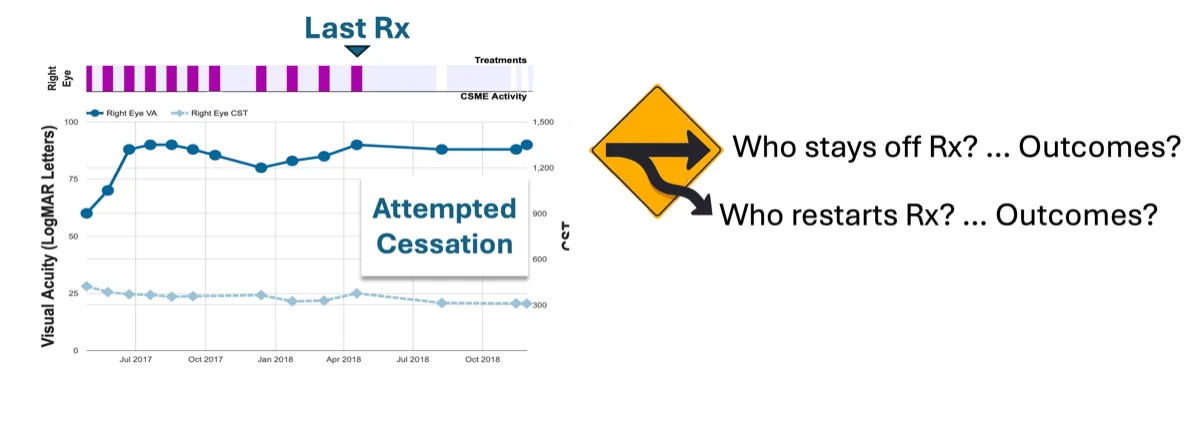
Patients receiving anti-VEGF injections for retinal vein occlusion (RVO) almost always ask the same question: will the injections ever stop? Treatment can continue for years, and clear guidance on when — and in whom — it can safely be paused has been limited.
A/Prof Adrian Hunt’s latest first-author study, published in the British Journal of Ophthalmology (2026), addressed this directly using real-world data from the Fight Retinal Blindness! registry at the Save Sight Institute. The study looked at eyes that had responded well to treatment, examined what happened when injections were suspended, and asked what distinguished the eyes that stayed stable from those that needed to restart.
Across 362 eligible attempts to suspend treatment, around half (51%) remained injection-free through two years. The eyes that succeeded tended to share a pattern: a stronger response early in treatment, and continued improvement during the first six months without injections. Eyes that were going to relapse generally showed signs — declining vision and returning retinal fluid — within that same window, allowing treatment to be resumed promptly.
What this means for patients: Many people with RVO understandably hope to reach a point where injections are no longer needed. This research suggests that for a substantial proportion of eyes that respond well, that point can be reached — and, just as importantly, it helps identify who is likely to manage without ongoing treatment and who should continue. Decisions about pausing treatment remain individual, made eye by eye and reviewed closely, but they can now be guided by real-world evidence rather than guesswork.